Decline and Fall

Paul Pennyfeather was reading for the Church at Scone College Oxford. The hapless Pennyfeather was relieved of his clothes by a group of drunks who didn’t like the look of Pennyfeather’s old school tie. In the words of the Master of Scone:

“‘The case of Pennyfeather,’ the Master was saying, ‘seems to be quite a different matter altogether. He ran the whole length of the quadrangle, you say, without his trousers. That is indecency. It is not the conduct we expect of a scholar.’”

For poor Pennyfeather it was downhill from then on. He ended up a teacher at a Llanabba Castle school in North Wales, a fourth-rate school according to the grading: Leading School, First-rate School, Good School, and School.

To find out what happens next, you will have to read Evelyn Waugh’s Decline and Fall.

The point is, it didn’t matter whether the removal of Pennyfeather’s trousers was voluntary or not; he was seen to be running trouserless; for appearances’ sake, something had to be done.

We will probably never know for sure whether Steve Wood was caught metaphorically sans-trousers, but the disastrous mess that ACNA has brought upon itself by thoroughly botching the plausible complaints against its most senior cleric means that, for the sake of appearances, it was almost inevitable that Wood was brought to trial.

Similarly, because appearances suggest that ACNA has been spending considerable energy in protecting the institution, I suspect that there will be pressure to find Wood guilty – to convince everyone that it’s doing no such thing.

The recent Report from the College of Bishops attempts to quiet the troops with vague promises to do better. I’m not sure that it reaches beyond the stage of advanced lip service.

I attended the first Provincial “Office Hours” with Bishop Dobbs and Provincial Leaders Zoom meeting. I was hoping for an interactive session with open discussion. Instead it was a format where questions were submitted in writing and the panel answered them – or didn’t.

My questions were:

  1. Why did it take so long to take the allegations against Steve Wood seriously – a year or more, I gather?

  2. It leaves one with the suspicion that it may never have been addressed had not the Washington Post article appeared. Comments?

The answer I received to part one was: that’s how long the process took. There was no comment on part two. This, it seems, is how you rebuild trust.

Anglican Church of Canada debates non-disclosure agreements

NDA’s have been used by the church to prevent victims of sexual abuse and other misconduct from discussing the abuse, presumably after reaching a settlement with the church.

Pressuring a victim to sign an NDA seems to me to be a rather tawdry attempt by the church to protect its increasingly tattered reputation.

In July, the ACoC discussed a motion to stop the use of NDAs in cases of abuse. No decision was made, and the debate was postponed for a later meeting.

That meeting occurred in early December and was reported on by the Anglican Journal  on December the 9th.

In an ironic twist that would be difficult to invent, the article is now the victim of an NDA: it has vanished and been replaced with the following:

Of course, not much really disappears from the Internet so, for your edification, here is the article:

CoGS debates resolution on non-disclosure agreements

It took Julie Macfarlane, now a retired professor of law at the University of Windsor, four decades to come forward about the sexual abuse she suffered at the hands of a Church of England priest when she was a teenager. So when the church asked her to sign a non-disclosure agreement (NDA), she refused.

“I said immediately to my lawyer that I’d spent 40 years keeping this a secret and I wasn’t going to sign an NDA now,” she said. The church did not pursue it any further, she said, and Macfarlane insisted on personally drafting new guidelines for NDA use to be used by Ecclesiastical Insurance as part of her eventual settlement.
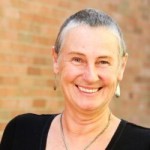
Julie Macfarlane Photo: Braunte Petric

Spurred by that first-hand experience, Macfarlane has since spent years urging churches, universities and other institutions to end the use of NDAs in cases of misconduct, abuse, harassment or discrimination with the organization she co-founded, Can’t Buy My Silence (CBMS). She has worked with Anglicans in Australia, the United Kingdom and Canada, including with the Rev. Jeffrey Metcalfe, who brought a resolution to June’s General Synod asking the national church to take its own stand against the misuse of NDAs.

Council of General Synod (CoGS) has now reopened discussion of that resolution, which called the church to scrap the use of non-disclosure agreements (NDAs) in cases of misconduct, discrimination or harassment. Metcalfe’s original resolution was the subject of intense discussion at June’s General Synod gathering after Canon (lay) Clare Burns, chancellor of General Synod, pointed out several clauses which she said posed problems of legal and insurance liability. The motion was deferred to CoGS, whose members picked it up at the council’s meeting this November.

In an informal breakout group discussion, CoGS members outlined the need for further information on the original purpose of the resolution and a clear breakdown of the specific dangers its current draft posed as discussed at General Synod. They also discussed what the role of the national church body should be in the discussion around NDAs. Summarizing on behalf of his table group, deputy prolocutor Brian Lee said General Synod’s role was to ensure that the intent of the resolution was implemented while accounting for any liability concerns involved.

“We need to keep the objective while getting rid of the pitfall,” he said. “[And also] not take too much of the fang out of it.”

Several dioceses across the Anglican Church of Canada are in the process of creating or passing resolutions curtailing or banning the use of NDAs.

When the original resolution was tabled in June, Burns (who has announced her intention to resign as chancellor by the end of 2025) pointed out several clauses she said were either impossible to implement or could expose the church to lawsuits. For example, one section instructed the church not to use NDAs unless the complainant asked for one “after having had the opportunity to obtain independent legal advice that includes advice on alternative means to protect the confidentiality of their personal information.” It is impossible for the church to verify the specifics of any advice a complainant receives from a lawyer, she said, as any such advice would be covered by attorney-client privilege.

Another clause directed the primate and officers of General Synod to contact any previous complainants and advertise the availability of pastoral support. Contacting a complainant after a settlement had been made could be a breach of the terms of the settlement, said Burns. Also, she added, pastoral supports are already part of any settlements the church makes with complainants in cases of misconduct. Reaching out to offer additional supports could be construed as saying that not enough had been offered to begin with, which she said might open the church to liability.

“It’s tantamount to saying that somehow we think more than what we’ve already done is needed. Our insurers are not going to let us do that. Or what they’re going to say to us is, ‘If you do it, you are not insured for whatever happens next,’” she said.

Burns said to her knowledge, General Synod has not requested any complainant sign a non-disclosure agreement at any time during the past 25 years. Speaking to CoGS in November, she also clarified that NDAs are distinct from non-disparagement clauses. The latter are not legally binding in the way NDAs are, she told CoGS. But she said the church does use them as a way of reminding signatories that the intent of a settlement is to put any further claims against the church to rest.

In June, Burns recommended the resolution be amended to include the phrase “subject to legal advice” in some sections she pointed out as problematic, allowing the church some discretion about how to implement them. The resolution’s mover and seconder, Metcalfe and Bishop Sandra Fyfe, of the diocese of Nova Scotia and Prince Edward Island, declined this phrasing due to concerns the church’s lawyers could be more likely to prioritize protecting the institution over the purpose of the resolution.

Nevertheless, Metcalfe told the Anglican Journal he is open to any good faith effort to redraft the resolution. He said he hopes any such redrafting reflects the broad agreement he heard at General Synod that many Anglicans want to prevent and repudiate any misuse of NDAs.

“I don’t think the chancellor, I don’t think Clare, would disagree with that,” he said. “I think it’s totally fair to say that the legislation we put forward is not perfect. I think my interest will be to see how the spirit of what it’s trying to put forward can be taken up in a way that helps achieve that spirit.”

Metcalfe’s home diocese of Quebec is one of several across the country which have drafted or are in the process of drafting similar resolutions ending or limiting their use of NDAs. Quebec’s resolution, passed in May, endorsed the principles embodied in—and asks its bishop to sign—the “faith pledge” put forward by anti-NDA nonprofit Can’t Buy My Silence (CBMS). It reads, in part, “We pledge never to request another party to submit to an NDA to stop them from raising complaints or discussing incidents of sexual harassment, abuse, or misconduct, discrimination, retaliation of bullying or other harassment.”

The diocese of Edmonton’s new safe church policy likewise contains language promising it will, “when appropriate, seek to limit the usage of nondisclosure agreements as a condition for the resolving or settling of a complaint.”

The Anglican Journal has also confirmed that the ecclesiastical provinces of British Columbia and Yukon and of Northern Lights are working on policies of their own.

The diocese of Nova Scotia and Prince Edward Island, meanwhile, has already passed a resolution ending its use of NDAs in cases of misconduct and endorsing CBMS’s faith pledge. It was not a difficult decision to make, said Cynthia Pilichos, the mover of the resolution and a member of the diocesan social justice organization Anglicans Powering Potential. That was in part because the use of NDAs is already illegal in Prince Edward Island in cases of discrimination, harassment or sexual misconduct unless the complainant asks for one. As a result, she said, the diocese cannot use them in that part of its coverage area anyway. And it has a choice whether it wants to look like it is ahead of the law in Nova Scotia or just doing what it is required to, she said.

“I think the church doesn’t make itself look very good when it’s hesitating on things like that. They don’t have a good track record with respect to sexual misconduct … with respect to the residential schools and the abuse and misconduct there.”

Pilichos said she first became interested in what she said is the harm NDAs can do when attending a talk at her local YWCA by Macfarlane and CBMS.  Macfarlane founded CBMS with Zelda Perkins, a former assistant of former film producer Harvey Weinstein, who has been convicted of rape and accused of more crimes by dozens of women. The organization advocates for reform in the use of NDAs and publishes research on the impacts they have on complainants who sign them.

According to a report published on its website, 93 per cent of respondents to a survey of people who either had signed an NDA or who “couldn’t say [if they had] for legal reasons” reported mental health impacts from having signed one. Respondents reported effects including anxiety, isolation and ongoing trauma. “The pressure to stay silent can exacerbate mental health issues, including depression and PTSD,” the report read.

While NDAs do not prevent signatories from speaking to therapists, counselors or trusted loved ones about their experiences, Macfarlane told the Journal, many either do not realize that or feel honour-bound to silence. The lawyers and organizations who use NDAs are not always aware of these impacts, she said.

“[Because] they’ve signed something, they feel obligated. And also, of course, there’s the threat that if they break it, they could lose whatever compensation they’ve received. So when I explain that to lawyers, 95% of them are like, ‘Oh my goodness, I had no idea.’”

CBMS’s faith pledge is one of several pledges the organization has created, with others targeted at universities, corporations and unions. They’re intended to put pressure on governments to push the issue forward by building a moral consensus, she said. Legal jurisdictions from P.E.I. to Texas, the United Kingdom and Australia have introduced bills banning NDA use in misconduct and discrimination cases, she added. So signing the pledge also offers organizations an opportunity to demonstrate their own concern over the issue before legislation reaches their jurisdictions, she said.

“To say, ‘Yes, we didn’t actually realize these were harmful and we’re not going to do them any longer’ … looks better than saying, ‘Okay, we’re going to stop doing it now because it’s illegal,’” Macfarlane said.

Karen Webb, chancellor of the ecclesiastical province of the Northern Lights and a member of the Anglican Journal’s editorial board, said the church has more to gain reputationally by promising not to use NDAs than it does by keeping them as an option. In the past, organizations have used them to try to prevent damaging allegations from going public, she said. But today, they make an organization look like it has something to hide while social media allows rumours to circulate anyway, she said. Conversations in her own province have concluded it is better for the church to show openness and—should a rare false accusation arise—prove its employee’s innocence rather than try to keep the issue out of the public eye.

Regarding the potential liability issues Burns pointed out in her speech at Synod, Macfarlane pointed to several churches which have made similar resolutions on NDAs, including the Anglican Church of Australia. Its synod passed a 2024 resolution against using NDAs and subsequently sent out an apology to all its past signatories, she said.

She could see why it might be a concern from a lawyer’s perspective that past signatories might take the offer of pastoral care recommended in the June draft of the resolution as an admission that not enough had been offered during settlement, she said. But she added that neither the Anglican Church of Australia nor any of the other institutions who have signed a CBMS pledge have so far had any problems with liability or anger from previous complainants. Instead, she said, not feeling silenced has given them less reason to be angry and less reason to take to social media with their grievances. “Lawyers are trained to be catastrophists,” she said. “So they put everything they can possibly think of into an agreement just in case there’s a 1 per cent chance.” This is also why she believes including the phrase “subject to legal advice” would render any resolution useless, she said—lawyers are likely to recommend every precaution available, including NDAs.

Asked to comment by the Anglican Journal, Burns replied to this point saying “Professor Macfarlane may find it unlikely that someone would sue but my job is to identify risks to the [General Synod], which I did.” She reiterated that the General Synod has not sought an NDA in any case during her time as chancellor or vice chancellor. Throughout the process, Burns has not made any statement to the Journal, General Synod or CoGS on how church leaders should legislate on NDAs beyond her comments on the problems she says are raised by the phrasing of the resolution on them.

At CoGS, members also mentioned that General Synod could play a role in leading a conversation on NDAs for dioceses and provinces across the Anglican Church of Canada with its resolution. However, decisions made at the national church are not binding on individual dioceses, which are free to make their own policies.

Correction: This article has been emended from an earlier version, which incorrectly stated that Burns had not made any comments to the Journal, General Synod or CoGS related to NDAs other than the problems she said are raised by the phrasing of the resolution.
Anglican Church of Canada warns against Christian nationalism

I think mixing politics and Christianity creates an unwholesome toxic brew that makes a mockery of the message of the Man/God who insisted his Kingdom is not of this world.

Unfortunately, that is exactly what the Anglican Church of Canada has been doing for decades. The politics of the ACoC veers consistently leftward. It is obsessed with climate change, gay and transgender propaganda, diverse inclusion, inclusive diversity, aboriginal land rights, a universal basic income – and so on.

It isn’t too interested in the sobering reality that Jesus died for our sins and offers us the free gift of reconciliation with God the Father, the acceptance or rejection of which determines our eternal destination.

Thus, it is a little rich that the ACoC feels called upon to denounce Christian Nationalism, an idea that, at least in part, seems to fuel the odious American MAGA mania.

As usual, the ACoC is tilting at windmills. A recent Pew Research poll determined that only 3% of Canadians are, in its words “religious nationalists”. Even the USA is only at 6%.

Interestingly, around 0.2% of Canadians admit to being transgender and the ACoC is also obsessed with them. All the madness of Don Quixote and none of the charm.

From here:

The Anglican Church of Canada believes that everyone is created in God’s image and that all members of society have an equal right to participate meaningfully in the public square at all levels. We have been enriched, as a church, by our relationships with other Christian denominations, along with the great variety of religious traditions that are found across our communities. Canada’s longstanding commitment to religious pluralism has enabled members of many faith communities and those with no faith commitment to live in civic harmony with one another without sacrificing their respective theological convictions.

A growing threat to this principle of pluralism and inclusion is the ideology of Christian nationalism, which seeks to merge Christian and Canadian identities, conflating them and distorting both Christian faith and Canada’s parliamentary democracy. Christian nationalism demands that Christianity be privileged by the state and implies that to be a good Canadian, one must be Christian. This ideology can provide cover for discrimination against marginalized groups and can increase threats and violence against religious communities at home and abroad. In that light, we denounce Christian nationalism as a distortion of the gospel of Jesus and a threat to Canadian democracy.

In our Baptismal Covenant, we promise to seek and serve Christ in all persons, to love our neighbours as ourselves, to strive for justice and peace among all people, to respect the dignity of every human being, and to strive to safeguard the integrity of God’s creation, and respect, sustain and renew the life of the Earth. These commitments lead us to call for the full inclusion and welcome of diverse voices engaging constructively in public debate, building connections across differences and celebrating the contributions of many communities to our collective wellbeing.

The Church, the Bible and homosexual practice

A guest post from Dr. Priscilla Turner:

Our Church is at odds with the Communion as a whole because decades ago she parted company in sex-ethics with the whole Church Catholic spread out in time and space. She hasn’t enjoyed the godly leadership of learned bishops who had eyes in their heads and brains between their ears about human biology, or submitted their minds to the scriptural witness about the Creator’s ordering of the world. She has tried to reopen an absolutely and completely closed question. She has become an enabler, by making her parishes institutionalised happy hunting grounds for sexual predators. Homosex has never been either in accord with natural law or pleasing to the Author of our human sexuality. And the Church Catholic has always known this.

There has been no reading of my esteemed friend and colleague Robert A.J. Gagnon’s big book The Bible and Homosexual Practice: Texts and Hermeneutics ISBN-13  978-0687022793

Or of mine with J.I. Packer, shorter, newer, Anglican, more theological:

Holy Homosex?: This and That (CreateSpace) A set of theological papers, including one by James I. Packer, presented in original chronological order, a thorough technical discussion:
SC 5.5×8.5: ISBN 9781482347869
HC 6×9: ISBN 9798872407768
Ebook: ASIN B07HXV8DFK

Text may be downloaded and read for nothing at: https://www.anglicansamizdat.net/wordpress/dr-priscilla-turner/

When all that is said, we really do not need any texts from any sacred book to know what to think of homosexuality. Hence as a whole no human society or culture in recorded history has ever favoured it.


Archbishop Steve Wood hit with sexual misconduct and abuse of power accusations

This doesn’t look good:

The highest-ranking member of the Anglican Church of North America has been hit with a slew of allegations – including sexual misconduct, abuse of power, and plagiarism.
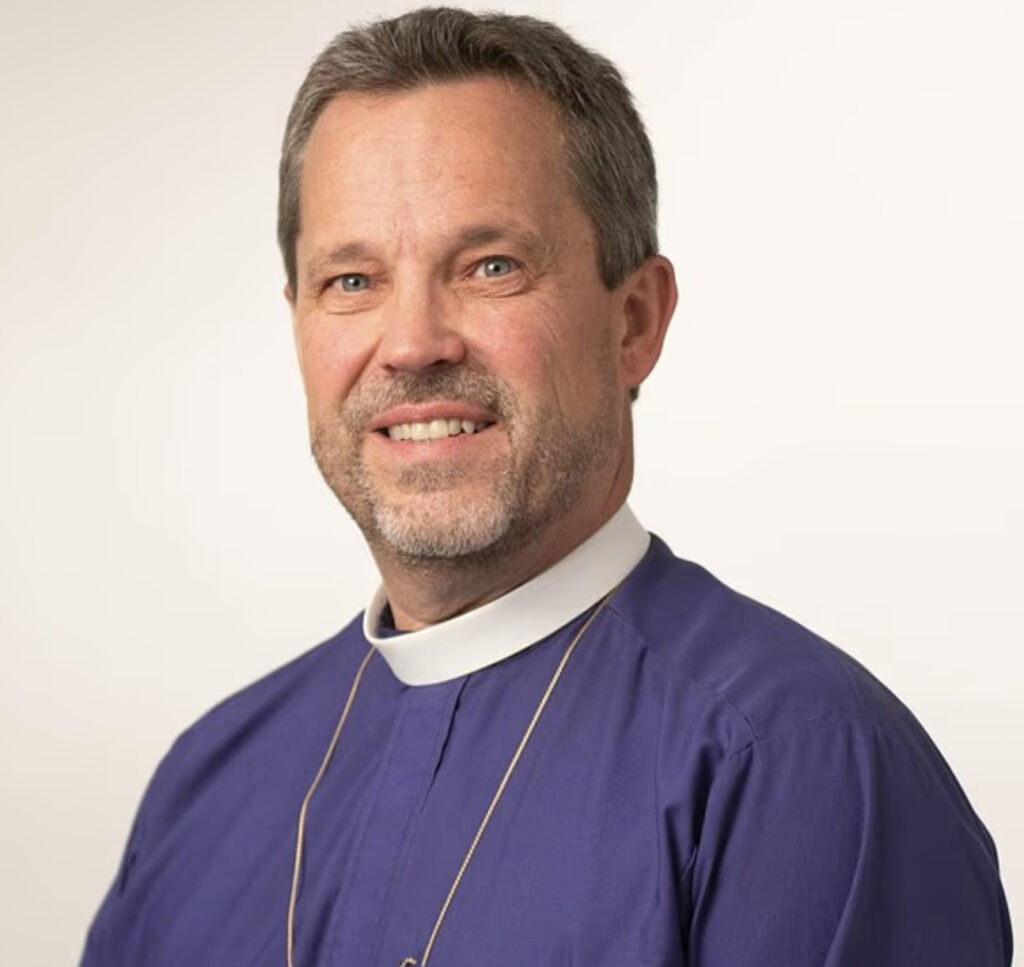
A recently revealed presentment, which is a formal report that details offenses by leaders in the church, alleges that Archbishop Stephen Wood, 62, attempted to kiss a female employee, plagiarized his sermons, and bullied church staffers before he moved up in rank.

The ACNA was founded in 2009 by former members of the Episcopal Church who opposed the congregation’s openness to LGBTQ+ Christians and progressive causes.

The religion is a form of Christianity, following the preaching in the Bible and celebrating traditional holidays like Christmas and Easter.

Over a decade after its inception, the church found itself riddled with controversy as new allegations surfaced against the ACNA’s senior-most official.

Claire Buxton, 42, has spoken out about her experience working as the children’s ministry director at St. Andrew’s Church in South Carolina while Wood was the rector.

Buxton detailed her experience in one of six affidavits submitted in the presentment, reviewed by the Washington Post, alleging Wood’s behavior.

She also claimed in an interview with the Post that last spring that Wood tried to kiss her in his office.

‘He put his hand on the back of my head and tried to turn it up towards him while he slowly brought his face towards my face to kiss me,’ Buxton told the outlet.

She said she avoided the kiss by dropping her head and gave him a side hug instead before running out of the office.

Although she said that the alleged kiss occurred in 2024, Buxton insisted that Wood’s inappropriate behavior began years before.

She told the Post that in October 2021 he hugged her at a celebration ceremony, and his hand slowly slid down her back.

Buxton said she told her parents about the awkward encounter, admitting that it felt ‘sensual’ and that she speculated he was attracted to her.

Her parents brushed it off, so she continued her work as the children’s ministry director.

However, a year later, Wood allegedly divulged inappropriate information to Buxton in his office.

He allegedly told her that he fired a church staffer because she ‘slept with everyone.’ That same year, Wood began giving Buxton mysterious checks from a church account.

[…….]

Numerous other members of the Anglican Church expressed concern with Wood’s behavior, including Reverend Hamilton Smith, the rector of St. Thomas’ Church in South Carolina.

In a letter obtained by the Post, Smith told Wood: ‘I do not feel you have moral authority required to hold the office of Bishop.’

Smith said he believed Wood plagiarized his sermons, shamed colleagues, and accepted a $60,000 truck provided by the diocese.

‘You have told me numerous times that you are a sinner who had “a really bad year/a horrible season” in which you did things you now regret. While I rejoice in this self understanding, grace and forgiveness have limits,’ Smith wrote in the letter.

Reverend Rob Sturdy, another priest who submitted an affidavit, wrote that Wood frequently boasted about a woman from another church whom he could’ve had a relationship with if he pursued it.

Canadian Primate values institution over truth

Archbishop Shane Parker has released a statement claiming that, whereas GAFCON has left the Anglican Communion, the Anglican Church of Canada will stay.

Whether that is accurate or not depends on how you define “Anglican Communion”. Here is a brief definition from Britannica:

Anglican Communion, religious body of national, independent, and autonomous churches throughout the world that adheres to the teachings of Anglicanism and that evolved from the Church of England. The Anglican Communion is united by a common loyalty to the archbishop of Canterbury in England as its senior bishop and titular leader and by a general agreement with the doctrines and practices defined since the 16th century in The Book of Common Prayer.

It’s true that Parker is holding to one part – “loyalty to the archbishop of Canterbury” – but not true that he is holding to the rest: “the teachings of Anglicanism” and “a general agreement with the doctrines and practices defined since the 16th century in The Book of Common Prayer.” He, the ACoC, the Church of England and TEC have departed from those practices.

Who, then, has really left the Anglican Communion: the vast majority of Anglicans who value biblical truth or an ever diminishing rump that loves the institution?

From here:

Pastoral statement from the Primate and Metropolitans of the Anglican Church of Canada concerning the Anglican Communion

By Archbishop Shane Parker on October 18, 2025

In recent days, primates of the Global Anglican Future Conference announced their decisions to leave the Anglican Communion. In response to this, we, the Primate and the Metropolitans of the Anglican Church of Canada, reaffirm the Solemn Declaration of 1893 found in the (Canadian) Book of Common Prayer:

We declare this Church to be, and desire that it shall continue, in full communion with the Church of England throughout the world, as an integral portion of the One Body of Christ composed of Churches which, united under the One Divine Head and in the fellowship of the One Holy Catholic and Apostolic Church, hold the One Faith revealed in Holy Writ, and defined in the Creeds. (BCP 1959/1962, viii)

We reaffirm the four Instruments of Communion: the Lambeth Conference, the Anglican Consultative Council, the Primates’ Meeting, and the primatial See of Canterbury with its people, clergy, and its Archbishop.

We reaffirm the historic Anglican appeal to Scripture, Reason, and Tradition.

The practical and theological question before us is this: Can communion with the Risen Christ contain conflict, so that conflict and disagreement lose their power to divide? We believe the answer to this question is a resounding “YES” because this has been borne out many times in Anglican experience and intuition from the Reformation to the present time.

The Anglican Church of Canada looks forward to participating in the next gathering of the Primates’ Meeting, the next meeting of the Anglican Consultative Council, and the next Lambeth Conference. We rejoice in the appointment of Bishop Sarah Mullally as the next Archbishop of Canterbury and will warmly welcome her to Canada after she is installed in 2026.

With steadfast faith and joyful hope,

The Most Reverend Shane Parker, Primate of the Anglican Church of Canada
The Most Reverend David Edwards, Metropolitan of Canada
The Most Reverend Anne Germond, Metropolitan of Ontario
The Most Reverend Gregory Kerr-Wilson, Metropolitan of Northern Lights
The Most Reverend John Stephens, Metropolitan of British Columbia and Yukon

Synod approves Queer Interfaith Coalition letter

Shouldn’t that be Interfaith Queer Coalition? Surely it’s the coalition that’s queer not interfaith.

No matter, the letter admonishes us to uphold the “sacred tenets of intersectional equity”, which I’m sure I’d be happy to do if I knew what it meant.

It also denounces “the damaging heresy that some people are more deserving of equality than others”. Now that I can get behind: I deserve to be equal to someone who is younger, taller, thinner, and better looking than me.

From here:

Queer Interfaith Coalition letter endorsed with amendment recognizing diversity of opinion on marriage canon General Synod passed a resolution June 29 endorsing an open letter to the Canadian government from the Queer Interfaith Coalition, an organization which supports LGBTQ+ acceptance across different religious groups.
The letter says it is “reclaiming the religious voice from those who have sought to weaponize faith.” Signatories commit to building religious communities that reflect a number of “sacred tenets of intersectional equity” including the idea that 2SLGBTQIA+ people are created “in the Divine Image,” and to, among other things, dedicating themselves to promoting the human rights and mental health of LGBTQ+ people and ending gender-based violence.

The motion passed after some debate surrounding a clause denouncing “the damaging heresy that some people are more deserving of equality than others,” and the passing of an amendment intended to address concerns about that clause. Many members of General Synod spoke in favour of the letter, including Bishop Kevin Robertson of the diocese of Toronto. He said there was a need for the church to stand up for LGBTQ+ rights at a time of growing backlash and diminishing support.

The amendment to the resolution states that General Synod will not understand the letter to contradict “A Word to the Church,” and that the word “heresy” “must not be interpreted as a condemnation of those Christians who do not believe Scripture permits Holy Matrimony for same-sex couple[s].” “A Word to the Church” is a document written by church leaders and adopted by General Synod in 2019. It affirms that Anglicans may hold a variety of beliefs about same-sex marriages, must stand together despite their differences and that the church must respect the self determination of Indigenous communities in particular.

Charlie Kirk and the silence of the Anglicans

When George Floyd was killed, in no time at all, Anglican bishops began parading their lamentations online.

Here is Linda Nicholls, who was at the time, Primate of the Anglican Church of Canada, expressing her dismay at “another black man killed by police brutality”. Fair enough: the death of George Floyd was brutal, he was black, and it was caused by a white policeman. The policeman who caused the death was convicted of unintentional second-degree murder, third-degree murder, and second-degree manslaughter. But he was not convicted of premeditated murder.

There was no shortage of other bishops eager to air their righteous indignation for all to admire. It wasn’t confined to ACoC and TEC bishops: not wishing to be left behind, here is a collection of ACNA bishops mourning and lamenting in unison.

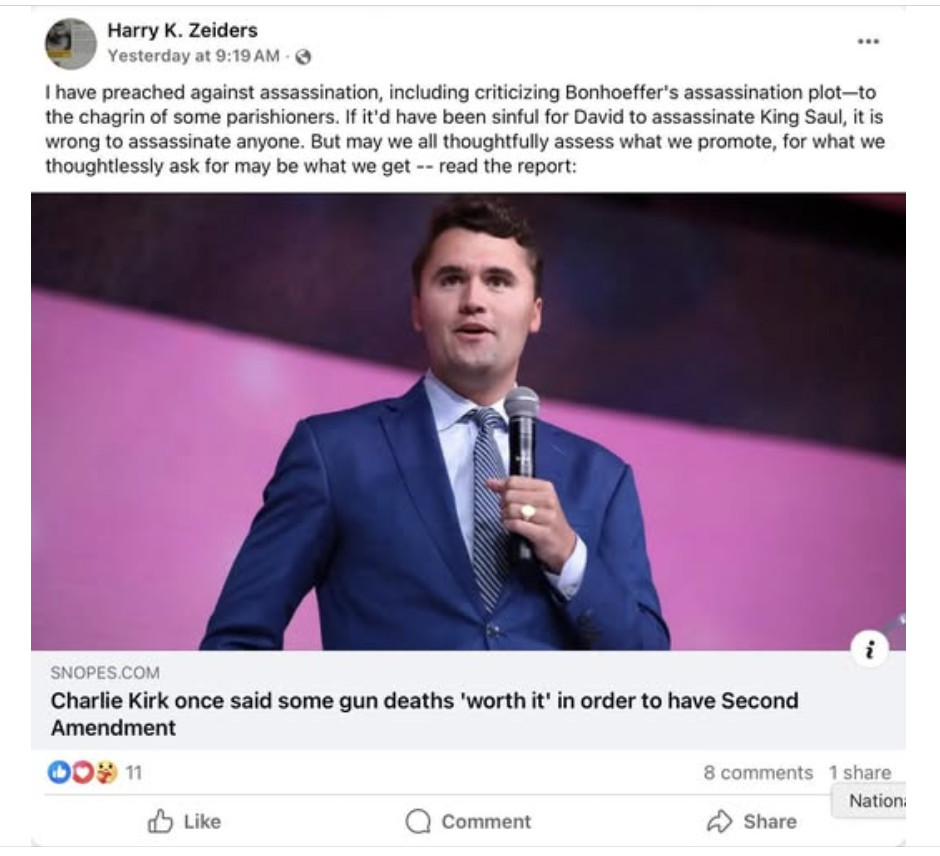
It is now five days since the horrific murder of Charlie Kirk, a conservative Christian who has been effectively defending orthodox Christian values to young people on US college campuses since he was 18. Unsurprisingly, this has rubbed some people up the wrong way, leading not only to his assassination but to celebrations of his assassination.

You might think that the bishops condemning George Floyd’s death would leap at this opportunity to once again write letters of mourning and condemnation at this dreadful murder.

But they haven’t. Shame on the lot of them.

The one exception I did find was from Bishop Phil Ashey, who at least had the decency to ask for prayers for the family.

Here is a disgusting Facebook post by ACNA’s Rev. Harry K Zeiders (recently removed, along with the foot from his mouth), implying that Charlie Kirk deserved what he got because of his support for the Second Amendment.

Ironically, Bernie Sanders – whose views don’t quite align with those of Charlie Kirk – posted one of the better comments on this:

The curious case of the Archbishop who doesn’t need to get married in church

I used to live in Machen, a small Welsh village about 12km away from where the new Archbishop of Wales, the Most Rev. Cherry Vann, is to be consecrated in Newport Cathedral. Much as I would enjoy visiting my old home, I won’t be using that as an excuse to attend Ms. Van’s installation as Archbishop.

Vann is collecting a catalogue of firsts to add to her résumé: she was the first female priest to be ordained in the UK, and now she is the first lesbian primate to be in a homoerotic relationship with her partner for the last 30 years.

What is curious about that, you may be wondering. After all, the only thing that the Anglican church can do that excites any interest in the secular press is to have yet another scandal exposed or to appoint a new archbishop with unusual sexual tastes. I’ve come to suspect that it’s all part of a devious Anglican strategy to be noticed.

The curious thing about it is that, while every liberal Western province is clamouring to enshrine same-sex marriage into their liturgies, this Archbishop says she doesn’t need to be married in church.

If an Archbishop doesn’t need to be married in church, why does anyone else?

Problem solved: there will be no same-sex marriages in churches because it isn’t needed.

From here:

The archbishop grew up in a religious family in Whetstone in Leicestershire, following in her church organist father’s footsteps by studying at the Royal College of Music and then the Royal Schools of Music, where she trained as a teacher.

She entered an Anglican theological college in 1986 to prepare for ordination and then worked in the Manchester diocese, becoming a priest in 1994 and archdeacon of Rochdale in 2008.

Gender and sexuality are still highly divisive issues in the Anglican communion. Even in her new role as the first female and first openly gay archbishop in the UK, Vann was cautious on the topic of gay marriage.

“I don’t personally feel the need to get married in church; Wendy and I have been together for 30 years, we’ve made our vows, and we are committed to each other.

ACNA continues burrowing down the woke rabbit hole

From here


ACNA’s New Vice-Chancellor for Safeguarding

In the midst of a difficult week for the Anglican Church in North America, there is a happy announcement: we have a Vice-Chancellor for Safeguarding, Jeannie Rose Barksdale! She has quite the resume, including a Stanford degree in Political Science and Comparative Studies in Race and Ethnicity.

Now in case any reader thinks Comparative Studies in Race and Ethnicity is grievance studies, you need to repent of noticing. Noticing is Whiteness.

Since then she has been busy, including being an active member of Church of the Advent, Washington, D. C., in the Diocese of Christ Our Hope. But she has found time to write. So let’s meet Jeannie Rose Barksdale in her own words.

Back in February, she found time to write for that erudite and balanced Christian publication, Sojourners. In it she is sad about a repeat shoplifter getting caught at Target. The shoplifter needed more love. She is also “feeling powerless and overwhelmed.” Why?

Lately, it has been far easier to despair than to love concretely. The Trump administration’s strategy of flooding the zone has made me feel powerless and overwhelmed — which is, as Adam Russell Taylor recently described it, precisely the point. Even while wrestling with lament, I’ve wanted to move toward contributing to addressing injustice to counter the pervasive injustice that occupies so much of our news. But I’ve just not known how.

Yes, the first days of President Trump II were so awful, it was difficult to love, to even know how to love. Oh, the “wrestling with lament”!

You may have guessed that I don’t much like Donald Trump. I think he is a bombastic, egotistical oaf. Having said that, I have to admit that what he has done has not been all bad: I tend to think of his positive achievements as happy accidents. Since they have all been bludgeoned into existence by executive order, they will all be undone in four years or so when an extreme leftist gets into power and uses the same technique. And I do not doubt that in four years the anti-Trump pendulum will swing with vengeance to the left.

Still, all this is temporal vanity that has little bearing on the eternal matters that should preoccupy the church.

So, if Ms Barksdale is in that much mental distress over wordly events that are largly beneficial – even though enacted by a buffoon –  and ACNA has hired her, both she and ACNA are in serious trouble.